Signs of balding: the Norwood scale and how to tell if you're losing your hair


Medically reviewed by the DIMA Medical Team
Updated · 7 min read
In this article
Key takeaways
- Early signs of balding: temples moving back, a thinning crown, more scalp showing in photos or bright light, and finer, shorter hairs.
- The Norwood scale grades male pattern baldness from stage 1 (no loss) to stage 7. Stage 3 is where doctors usually call it balding.
- Asian men often thin on top while keeping more of the front hairline, so don't only watch your temples.
- Start early. Finasteride and minoxidil work best on hair that's thinning, not on skin that has been bald for years.
Not sure if you're balding?
Take the free 2-minute hair check. A licensed Filipino doctor reviews your answers and tells you if finasteride and minoxidil are right for you.
See if finasteride and minoxidil are right for youWhat are the first signs of balding?
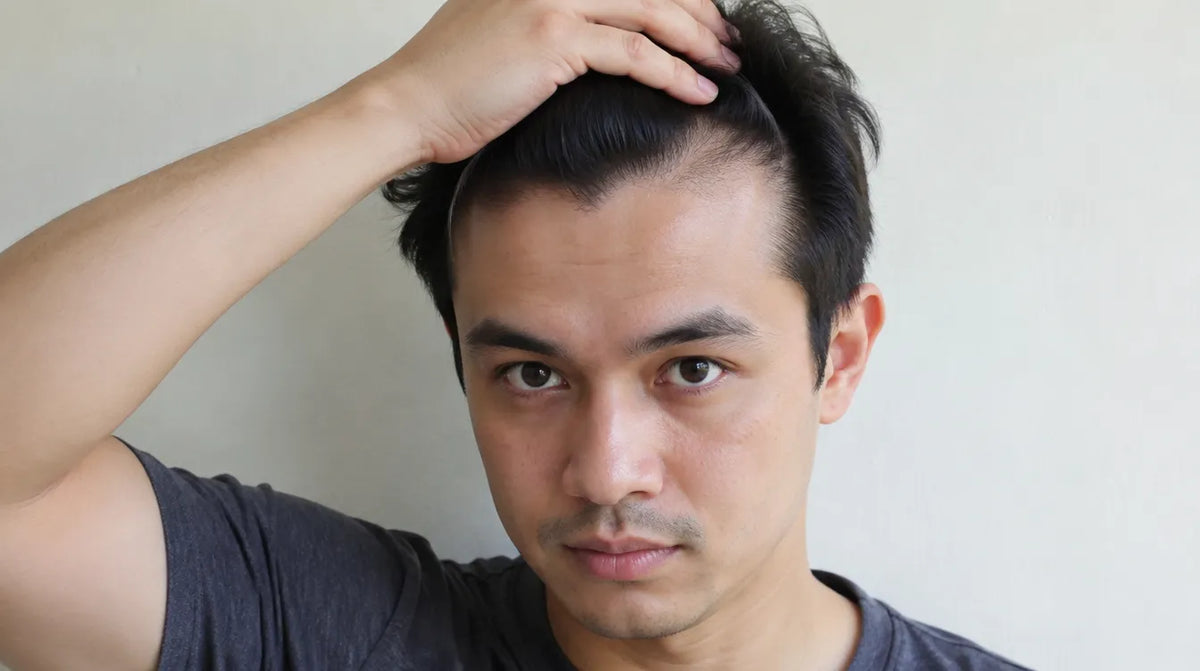
The first signs of balding are a hairline that moves back at the temples and hair that thins at the crown. Male pattern baldness is slow. Most men notice it in photos, under strong light, or when a barber mentions it, long before anyone else does.


Hair on the pillow or in the drain on its own is not a reliable sign. Everyone sheds 50 to 100 hairs a day. Read hair fall vs hair loss to tell the two apart.
What is the Norwood scale?
The Norwood scale is the standard way doctors grade male pattern baldness, from stage 1 to stage 7. Doctors use it to describe how far hair loss has gone and to track whether treatment is working.


| Stage | What it looks like | What it means |
|---|---|---|
| 1 | Full hairline, no visible loss | No balding |
| 2 | Slight, even recession at the temples | Often a normal mature hairline, but can be the start of balding |
| 3 | Deeper recession at the temples (clear M or V shape) | The first stage counted as balding |
| 3 vertex | Stage 2 hairline plus thinning at the crown | Balding that starts at the crown |
| 4 | Further loss at the front and a bald area at the crown, with a band of hair between them | Moderate balding |
| 5 | The band between front and crown becomes thin | Advanced balding |
| 6 | The front and crown join into one bald area | Advanced balding |
| 7 | Only a horseshoe-shaped band remains at the sides and back | Most advanced stage |
Does balding look different in Filipino and Asian men?
Yes, a little: Asian men are more likely to keep their front hairline and thin on top. A study of more than 5,000 Korean men found that many kept their frontal hairline while hair thinned evenly over the top, a pattern the Norwood scale doesn't describe well. Male pattern baldness is also somewhat less common in East Asian men than in white men, but it still rises steadily with age. In a large study in China, about 1 in 5 men had it, from under 3% of men aged 18 to 29 to over 40% of men aged 70 and older.
So if your hairline looks fine, also check the top and crown. More scalp showing on top under bright light is a sign worth taking seriously.

Is it balding or just a mature hairline?
A mature hairline rises a little and evenly across the forehead in your late teens and twenties; balding keeps going and goes deeper at the temples. Almost every man's hairline moves up slightly as he leaves his teens, which is Norwood stage 2 and is normal. It becomes balding when the temples keep receding year after year, the hairs at the front turn fine and wispy, or the crown starts to thin too. Our guide to the receding hairline covers this in more detail.
How can I check if I'm balding at home?
Take the same photos every month and compare them. Your memory and your bathroom mirror are not reliable judges.
- Photograph your hairline from the front with your hair pushed back, plus each temple from the side.
- Photograph your crown from above (ask someone, or use your phone's timer).
- Use the same place, light and hair length every time. Dry hair, no products.
- Compare every 3 to 6 months. Look for higher temples, a wider crown spot and finer hairs.
- Think about family. Balding fathers, uncles or grandfathers on either side make male pattern baldness more likely.
What should I do if I see signs of balding?
Start a proven treatment early, because it's far easier to keep hair than to regrow it. Male pattern baldness is caused by DHT, a hormone that slowly shrinks hair follicles in men whose genes make them sensitive to it. Without treatment it usually keeps moving up the Norwood scale.
Finasteride 1 mg lowers DHT. In large 2-year trials it stopped hair loss in most men, at the crown and at the front of the scalp. Oral minoxidil 2.5 mg helps thinning hairs grow longer and thicker, in one small tablet a day. Together they usually work better than either alone. Read more in our guide to hair loss treatment for men.

From DIMA
Finasteride + oral minoxidil
- Finasteride 1 mg slows the cause; oral minoxidil 2.5 mg helps hair grow back
- One small tablet of each a day, no lotions
- Prescribed after a free online doctor review, with no lock-in and cash on delivery
If you'd rather start with one medicine, finasteride targets the cause directly.

From DIMA
Finasteride 1 mg: stops the cause
- One 1 mg tablet a day that lowers DHT, the hormone behind male pattern baldness
- Registered with the Philippine FDA
- Prescribed after a free online doctor review, delivered nationwide with cash on delivery
See a doctor in person if you have
Round, smooth bald patches, patches of missing eyebrow or beard, a red, scaly, painful or scarred scalp, or sudden heavy hair loss all over. These are not typical male pattern baldness.
Frequently asked questions
At what age does balding start?
It can start any time after puberty, sometimes in the late teens, and becomes more common with every decade of age.
Can you stop balding at Norwood 2 or 3?
Usually yes. Finasteride and minoxidil stop or slow hair loss in most men and work best at these early stages, as long as you keep taking them.
Can hair grow back at Norwood 4 or 5?
Thinning areas can often thicken with treatment, but skin that has been smooth and bald for years rarely grows hair again; a hair transplant is the main option there.
Is balding inherited from your mother's side?
Genes from both parents play a part, so look at men on both sides of your family, not only your mother's father.
Does wearing a cap cause balding?
No, a normal cap doesn't cause male pattern baldness; only very tight headwear that rubs or pulls the same spot every day can damage hair.
Is balding curable?
Male pattern baldness can't be cured, but daily treatment can stop it in most men and regrow some hair for as long as you keep using it.
Sources
- Norwood OT. Male pattern baldness: classification and incidence. South Med J 1975;68:1359–65.
- Hamilton JB. Patterned loss of hair in man: types and incidence. Ann N Y Acad Sci 1951;53:708–28.
- Paik JH, Yoon JB, Sim WY, Kim BS, Kim NI. The prevalence and types of androgenetic alopecia in Korean men and women. Br J Dermatol 2001;145:95–9.
- Wang TL et al. Prevalence of androgenetic alopecia in China: a community-based study in six cities. Br J Dermatol 2010;162:843–7.
- Rassman WR, Pak JP, Kim J. Phenotype of normal hairline maturation. Facial Plast Surg Clin North Am 2013;21:317–24.
- Kaufman KD et al. Finasteride in the treatment of men with androgenetic alopecia. J Am Acad Dermatol 1998;39:578–89.
- Leyden J et al. Finasteride in the treatment of men with frontal male pattern hair loss. J Am Acad Dermatol 1999;40:930–7.
- MedlinePlus Genetics (US National Library of Medicine). Androgenetic alopecia. medlineplus.gov.
This article is general information, not a prescription. A licensed doctor decides whether any treatment is right for you.
Find out what will work for your hair
Take the free 2-minute hair check. A licensed Filipino doctor reviews your answers. No lock-in, and COD is available.
Take the free hair checkWhy trust DIMA
Every DIMA article is reviewed by our medical team of licensed Philippine physicians, and every treatment request is reviewed by a doctor before anything is sent.

Dr. Rhea Katrina Salomon
General Practice
PRC Licensed

Dr. Deano Reyes
Gender and Sexual Health Specialist
PRC Licensed

Dr. Patrick Paolo Abarquez
Internal Medicine · Endocrinology
PRC Licensed

Dr. Ame Lopez
General Practice
PRC Licensed

Dr. Thaddeus Averilla
Internal Medicine
PRC Licensed

Dr. Bernadette Yap Abela
General Practice
PRC Licensed
